Dutch agricultural publication Nieuwe Oogst recently covered an emerging greenhouse technology: spectral selective solar panels from Swiss company Voltiris. These panels split sunlight into its useful and heat-carrying components — passing PAR light through to the crop while reflecting near-infrared (NIR) radiation to electricity-generating cells. The result: a cooler greenhouse and usable energy from the same roof. Sigrow was mentioned for monitoring plant temperature at the Delphy Improvement Centre trial in Bleiswijk.
It is an interesting approach to a problem every grower knows. On a sunny summer day, radiation pours into the greenhouse faster than the crop can use it. The excess becomes heat. Ventilation goes up, humidity drops, and VPD shoots past the crop’s comfort zone. The crop closes its stomata and transpiration stalls — exactly when the plant should be growing hardest.
How spectral filtering changes radiation management
Traditional approaches to managing excess radiation — screens, whitewash, ventilation — all have trade-offs. Screens block PAR alongside the heat. Whitewash is static and washes off. Ventilation loses CO₂ and humidity. Spectral filtering takes a different angle: let the photosynthetically active light through and redirect the wavelengths that only add heat.
In the Voltiris setup, moving panels in the greenhouse ridge follow the sun and can generate around 250 MWh per hectare per year in the Netherlands. Early results from strawberry trials showed a 9% revenue increase and larger fruit — effects that link directly to lower crop stress during peak radiation hours. These are the kinds of improvements that become visible when you track Plant Empowerment step 2: radiation management.
Why plant temperature monitoring matters here
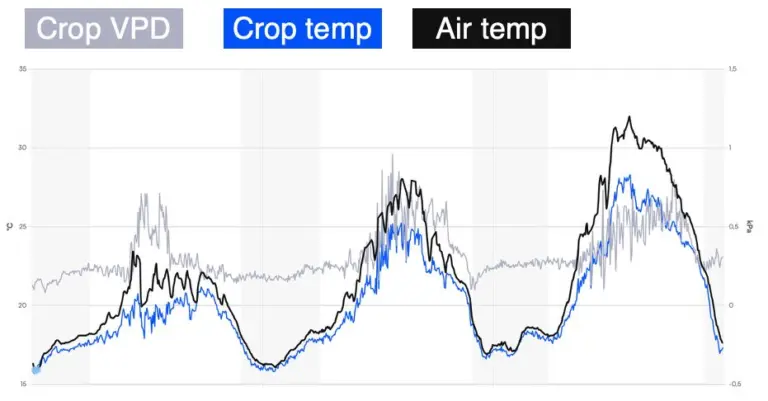
A panel that claims to reduce heat in the greenhouse is only as credible as the data backing it up. That is where crop-level temperature measurement comes in. Measuring air temperature alone is not enough — two greenhouses can show the same air temperature while the crop in one is 3 °C warmer than the other because of differences in radiation load, airflow, and transpiration rate.
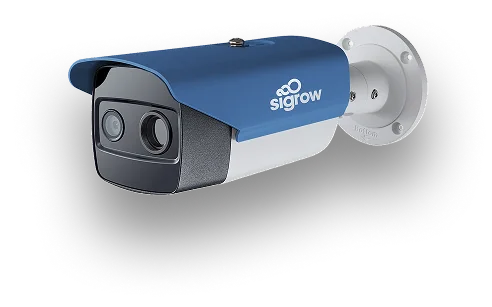
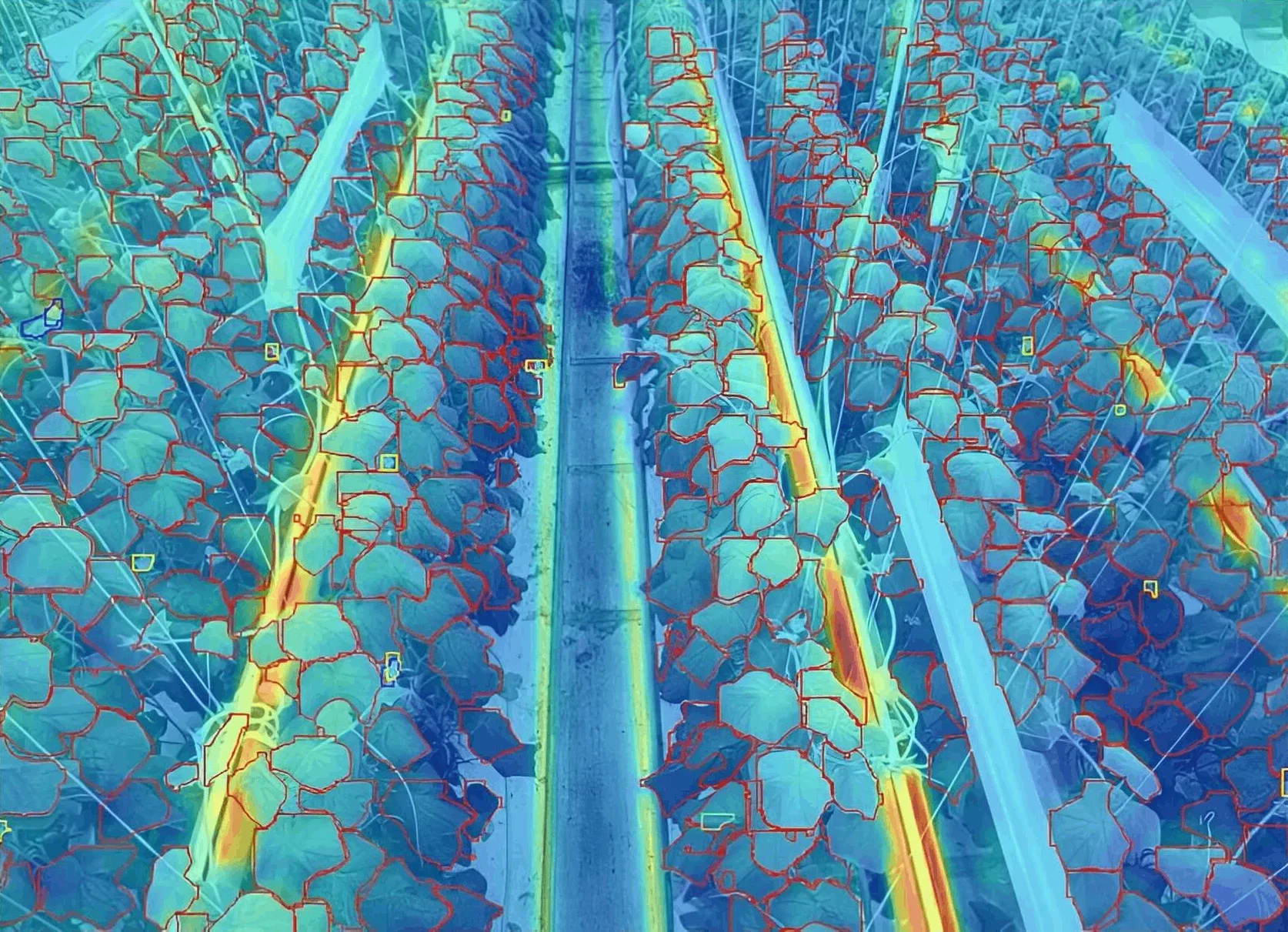
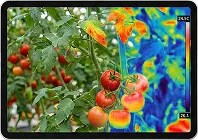
Sigrow’s Stomata Camera measures leaf temperature, stomatal behavior, and leaf-level VPD directly on the crop. This is the kind of measurement that can objectively quantify whether a spectral filter, a new screen strategy, or any other climate intervention actually reaches the plant — not just the air sensor hanging a meter above the canopy.
Radiation in, heat out — measuring the balance
Spectral panels work on the radiation side of the energy balance. But growers making investment decisions about these systems need to see the downstream effect on the crop: did leaf temperature drop? Did VPD stay in the target range longer? Did transpiration hold steady through the midday peak instead of shutting down?
These are questions you can answer with continuous crop monitoring. The Net Radiometer measures the net radiation reaching the crop canopy, while the Stomata Camera tracks how the plant responds to that radiation. Together, they give a complete picture of the energy balance from roof to leaf — exactly what you need to evaluate whether a technology like spectral filtering is delivering on its promise in your specific situation.
The bigger picture: data-driven climate decisions
Whether it is spectral panels, new screen strategies, or ventilation protocols, the pattern is the same: growers need crop-level data to make confident decisions about their climate strategy. Air temperature and a box sensor do not tell you what is happening at the leaf. And with energy costs, water scarcity, and crop quality demands all pushing in different directions, the margin for guessing is shrinking every season.
Sigrow’s Stomata Camera measures crop temperature, leaf-level VPD, and stomatal behavior directly, while Air+ and Air Pro+ track greenhouse microclimate conditions. You can also check your own numbers with our free VPD calculator.
This article references reporting by Bernadette Kroon in Nieuwe Oogst. Read the original article →
Want to discuss radiation management and crop temperature monitoring in your greenhouse? Reach out to the Sigrow team at success@sigrow.com (Mon to Fri, 9:00 to 18:00 CET) or support@sigrow.com (Mon to Fri, 9:00 to 21:00 CET).
Follow Sigrow on LinkedIn for more insights from the field.
Author

Related Blogs

- Grower Insights
By SigrowWarm Days, Cold Nights: Why Your Tomato Crop’s Dew Point Margin Matters
A respectable 24-hour average can hide a night on the dew point and…- Grower Insights
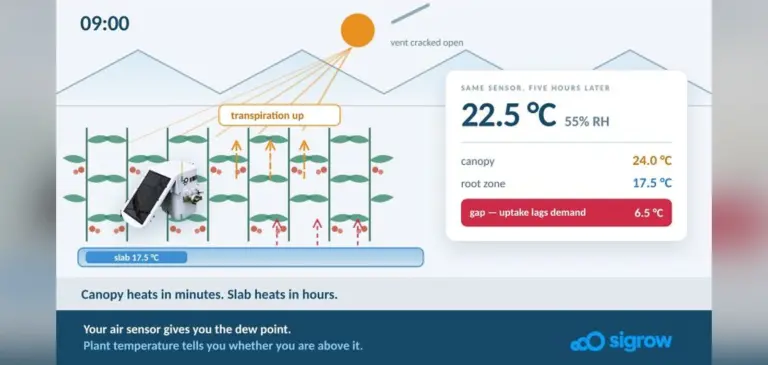
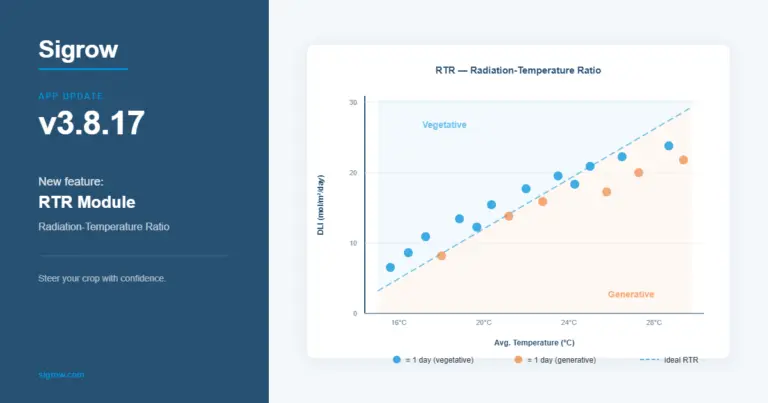
By SigrowMore Light or More Temperature? How RTR Answers the Question
Light makes the sugars, temperature spends them. RTR connects the two and shows…- Grower Insights
By SigrowLimiting Ventilation in a Heatwave: What Crop VPD Shows
Air and crop temperature both climbed for days. Crop VPD stayed below stress…

No Related Blogs Found
120-Day Promise
Try Sigrow for 120 days, risk-free. If it does not get your operation under tighter control, send the system back for a full refund of the hardware and the software subscription paid to date — no restocking fee.
We’re here to support you.
Questions, assistance, or just want to chat – reach out!