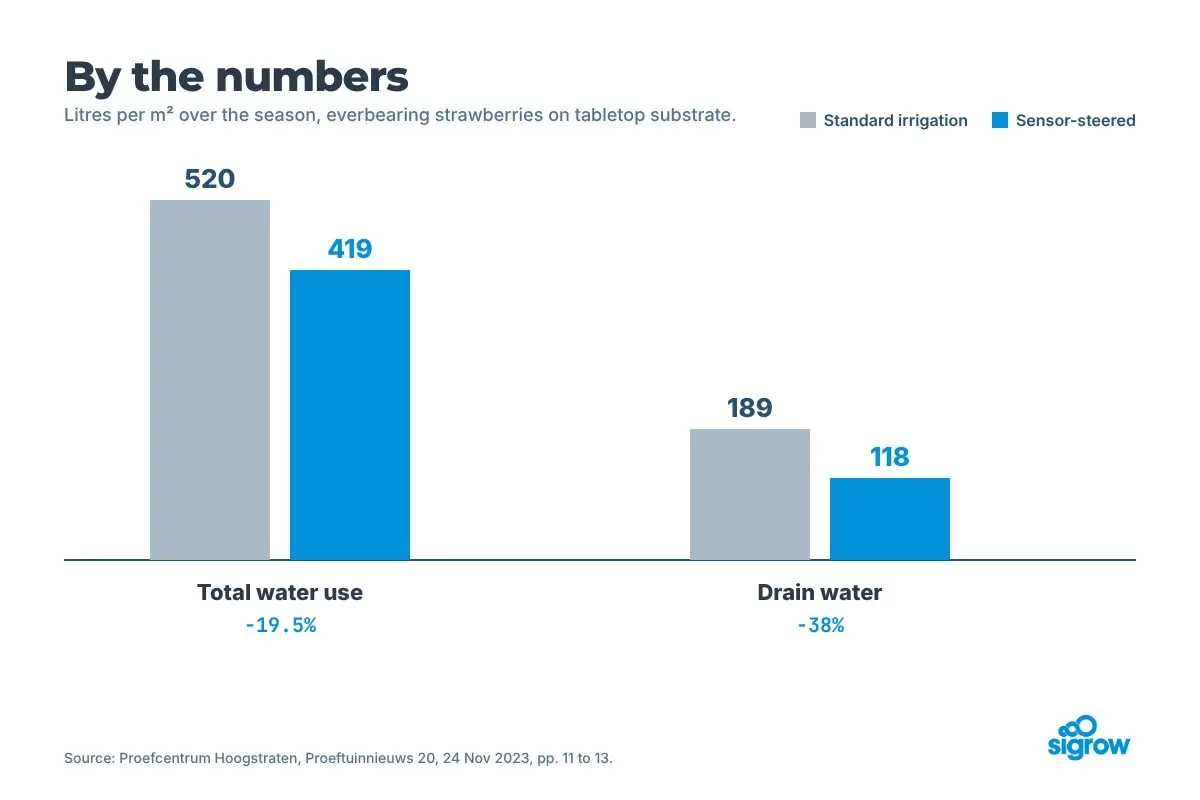
38%. That’s how much less drain water a strawberry crop at Proefcentrum Hoogstraten produced when irrigation was steered on substrate sensor data. Total water use fell 19.5%. Yield didn’t fall at all.
For anyone who pays for water, fertiliser or drain disposal, those are numbers worth unpacking.
There is no single right greenhouse drain percentage, but this trial shows that many growers carry more drain than the crop needs.
By the numbers
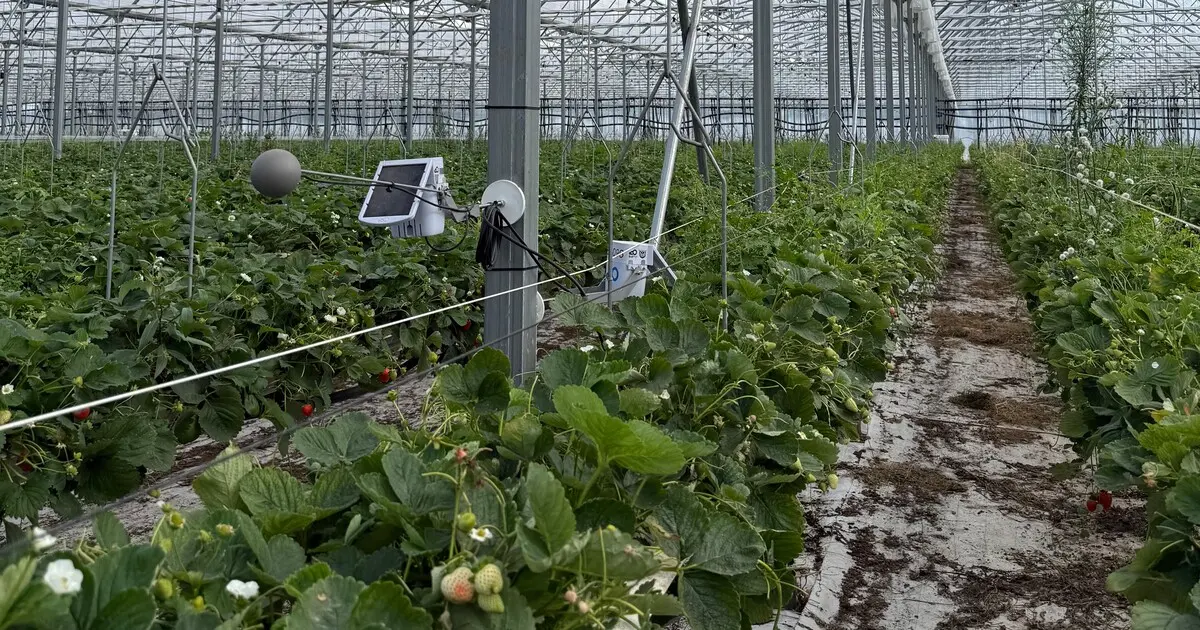
The 2023 trial ran at Proefcentrum Hoogstraten in Belgium, part of the EU LIFE ACLIMA project (LIFE20-CCA-BE-1720). The crop was everbearing Karima strawberries on a free-draining tabletop system, monitored with six Soil Mini sensors.
| Measure | Standard irrigation | Sensor-steered irrigation | Change |
|---|---|---|---|
| Total water use | 520 L/m² | 419 L/m² | −19.5% |
| Drain water | 189 L/m² | 118 L/m² | −38% |
| Drain fraction | 36.3% | 28.2% | −8.1 points |
Yield held at about 2 kg per plant, with 75% large fruit. Firmness, Brix, visual quality and shelf life didn’t change.
The results were published by P. Melis, S. Laurijssen, M. Hofkens and V. Greffe of Proefcentrum Hoogstraten: “Drain in aardbeien te beperken met behulp van sensoren”, Proeftuinnieuws 20, 24 November 2023, pages 11 to 13.
What moved, and why
Most of the savings came out of the drain. That’s the water that ran through the substrate and out of the bottom without the plant using it. Total water fell by 101 L/m², and 71 L/m² of that was drain.
The mechanism is simple. When you irrigate on a timer or a fixed light sum, you build in a safety margin: water the crop might need, just in case. Steering on substrate water content lets you see when the root zone actually needs water, so the margin can shrink. In the trial, the team kept at least 40% moisture in the root ball and 30% in the free substrate, with drain EC between 1.1 and 1.3 mS/cm.
The detail that matters most
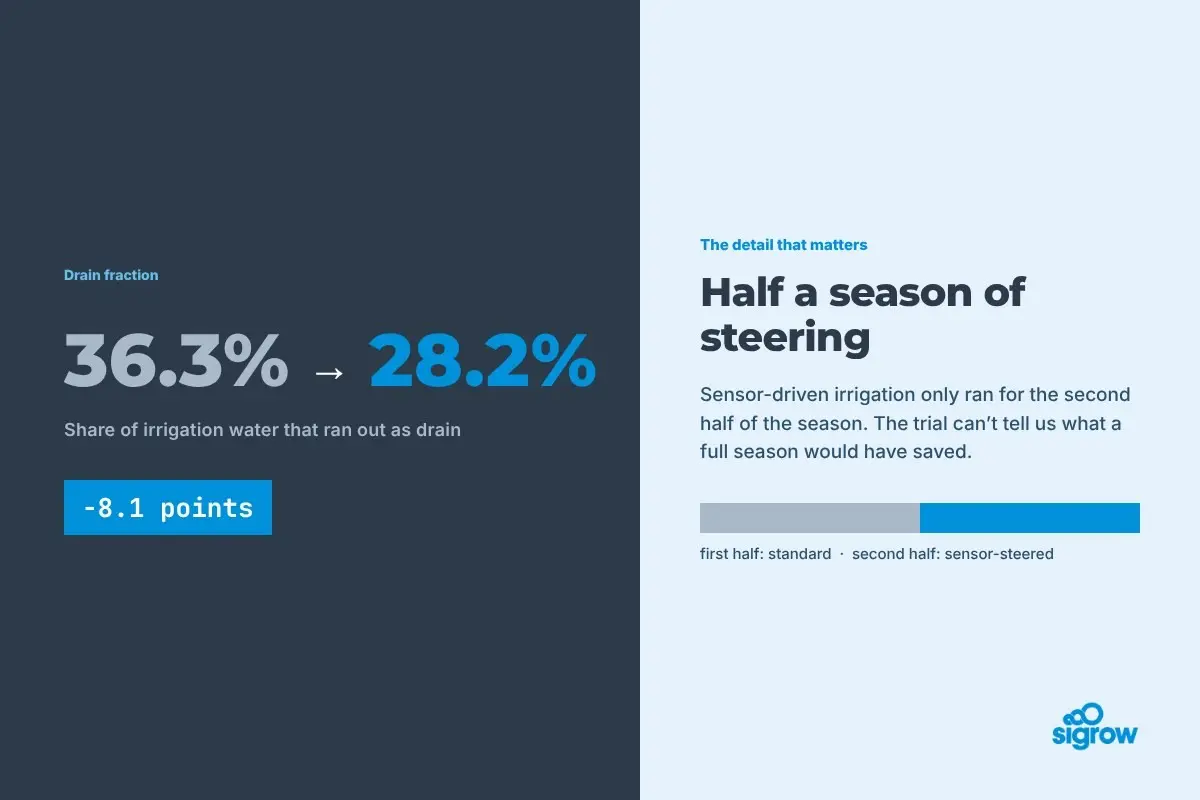
Sensor-driven irrigation only ran for the second half of the season, so the saving above came from half a season of steering. The trial doesn’t tell us what a full season would have saved, though the researchers expect it would be more. One more honest detail: substrate EC in the root balls rose to 8 to 9 mS/cm while drain EC stayed at 1.3 to 1.8, so the team steered daily on drain EC, not on substrate EC.
So how much drain is enough?
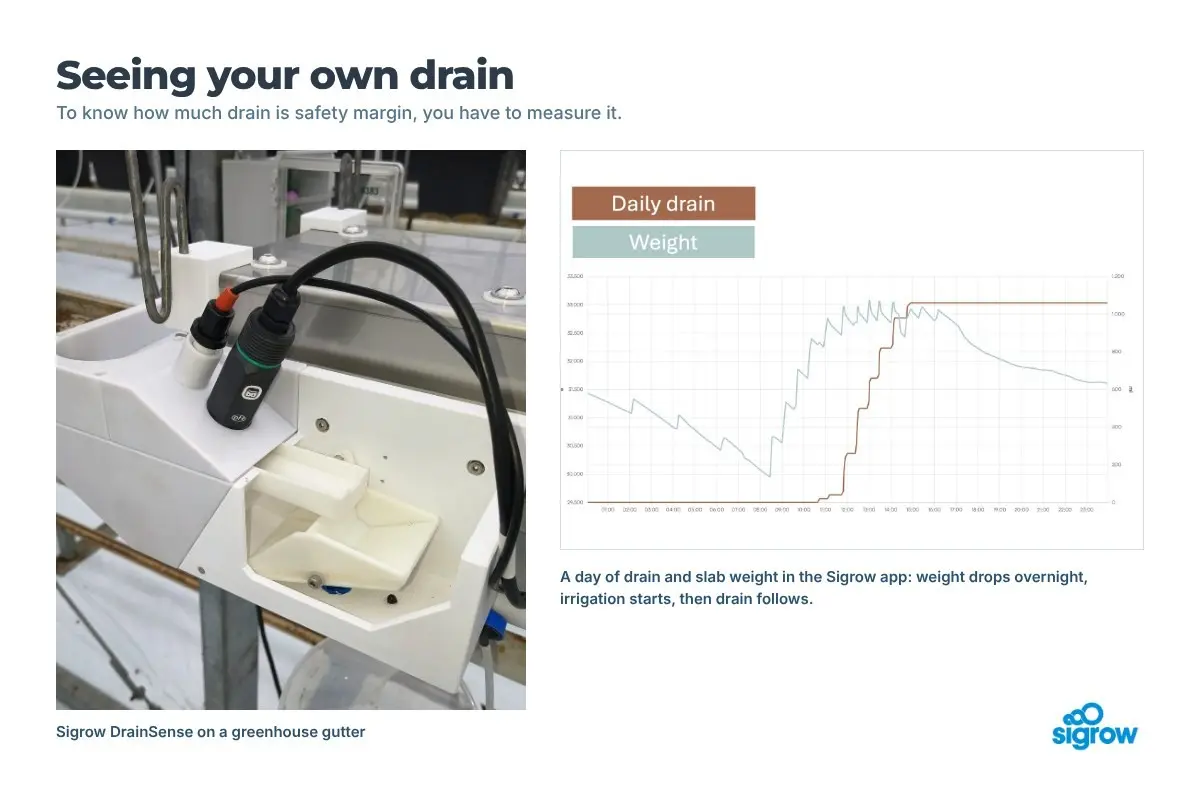
There’s no single right drain percentage. It depends on your crop, your substrate, the quality of your water, the season and the salts building up in the root zone. Drain is how you flush those salts and keep the root zone even, so cutting it blindly is a risk.
What the trial shows is that many growers carry more drain than the crop needs. The question isn’t “what’s the textbook percentage?” It’s “how much of my drain is safety margin, and how much is doing a job?”
To answer that, you need to see three things:
- Water content in the root zone, so you know when the substrate is actually drying.
- What leaves the root zone: drain volume and drain EC, so you know how much you’re flushing and what’s in it.
- Where it differs: dry zones and wet zones across the greenhouse, so one sensor doesn’t set the dose for everything.
The tools on each side of the root zone
In the substrate. The Soil Mini is a portable, wireless spot-check sensor with a rechargeable battery that lasts about 6 months per charge. It measures substrate water content, EC and temperature in rockwool, coco peat, soil and perlite. Growers use it to find dry zones, hot spots and uneven irrigation, and report up to 20% water reduction and 15% crop uniformity improvement. The Soil Pro+ does the same job continuously.
In the drain. DrainSense is a complete stainless weighing gutter with a drain station. It carries 2 m rockwool slabs or a row of pots, weighs them to ±3 g at a 45 kg gutter load, even with a 10 °C change in ambient temperature, and measures drain volume, EC, pH and temperature every 5 minutes. It resolves drain EC shifts under 0.3 mS/cm in real time.
What to watch
- Your drain fraction per irrigation day, not per week.
- How long the substrate takes to dry back after the last shot.
- Whether drain EC stays steady as you trim the dose.
- Whether the driest and wettest spots in the greenhouse move closer together.
FAQ
What is a good drain percentage in a greenhouse?
It depends on crop, substrate, water quality and season. In the Hoogstraten strawberry trial, the drain fraction went from 36.3% to 28.2% with no loss of yield or quality.
How can I reduce water use without losing yield?
Steer irrigation on measured substrate water content instead of a fixed schedule, and watch drain volume and EC as you reduce the dose.
Why do I need to measure drain EC?
Drain EC tells you whether salts are building up in the root zone as you change the irrigation. It’s your safety check when you cut drain.
The number to start with
You don’t need a trial to make a start. Work out last week’s drain fraction per irrigation day and write it next to the yield you got. That’s your baseline, and everything above is about how far it can move. The full strawberry case study has the trial details.
Author

Related Blogs

- Grower Insights
By Timon van LemmenWarm Days, Cold Nights: Why Your Tomato Crop’s Dew Point Margin Matters
A respectable 24-hour average can hide a night on the dew point and…- Grower Insights
By SigrowSpectral Solar Panels Keep Greenhouses Cooler — Why Plant Temperature Monitoring Matters
Nieuwe Oogst covers Voltiris spectral panels that filter NIR while passing PAR light….- Grower Insights
By SigrowMore Light or More Temperature? How RTR Answers the Question
Light makes the sugars, temperature spends them. RTR connects the two and shows…

No Related Blogs Found
120-Day Promise
Try Sigrow for 120 days, risk-free. If it does not get your operation under tighter control, send the system back for a full refund of the hardware and the software subscription paid to date — no restocking fee.
We’re here to support you.
Questions, assistance, or just want to chat – reach out!