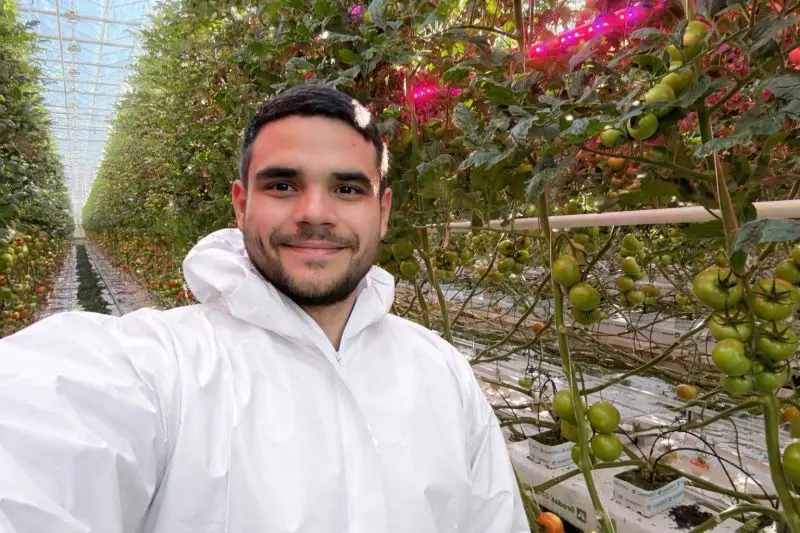
I was speaking with a grower the other day about his climate strategy, and he told me: “This summer we will have heat stress again on the crop.”
Summer is almost here, and with it come high greenhouse temperatures. The greenhouse air goes above 30°C, and what is often the first reaction? Open the vents fully.
Why opening the vents doesn’t always fix greenhouse heat stress
But does fully opening the windows really solve heat stress?
Or does it simply create another problem: losing the CO₂ you are dosing straight out of the greenhouse, while also losing humidity through the vents?
That is an important point, because while ventilation cools the greenhouse down, it also often increases VPD even more by removing humidity. In many situations, the increase in VPD caused by humidity loss is larger than the reduction in VPD achieved by lowering the temperature.
Limiting ventilation to protect crop VPD in the heat
What if the solution is actually the opposite?
At Sigrow, we’ve been discussing a different strategy with growers: limiting ventilation during periods of heat. At first, this sounds counterintuitive. Less ventilation means higher temperatures, right? Yes, it does. But temperature alone is not what stresses the crop.
The real issue is often high VPD combined with high temperatures. When ventilation is reduced, less humidity escapes through the vents, RH increases, and crop VPD can remain within a healthy range, even when temperatures exceed 30°C. And that changes everything.
Why a crop can thrive above 30°C when crop VPD stays below 1 kPa
A crop with a VPD below 1 kPa can still operate very efficiently, with good stomatal opening and strong CO₂ uptake, even with high temperatures. In practice, this means that high temperature does not automatically equal crop stress. In fact, when CO₂ levels are kept high (800 to 1000 ppm), the optimal photosynthesis temperature shifts upward. Combine:
- High temperature
- High humidity
- High CO₂
- Healthy crop VPD
…and the plant can actually become more productive. For people, that greenhouse climate may feel terrible. For the crop, it is ideal.
Crop-centric data: measuring crop temperature and crop VPD
This strategy only works when you understand the crop response. Measuring only air temperature or air VPD is not enough. Crop-centric data such as crop temperature and crop VPD are essential to know how far you can push ventilation without entering stress.
What this looked like for one grower
We recently saw this exact strategy in practice with one grower:
- Air and crop temperatures increased over 3 days
- RH also increased
- But crop VPD remained stable and below stress levels (even below 1 kPa)
Looking only at temperature, you would conclude the crop was under stress. Looking at crop VPD, you would see a highly performant crop operating close to its optimum. By limiting ventilation, the grower avoided heat stress and turned “stress conditions” into a turbocharged growing environment.
This is a perfect example of why crop-centric data matters.
What do you think about this strategy? Does it sound counterintuitive? Suspicious even? Let’s discuss it! My colleagues at Sigrow and I are always happy to explain!
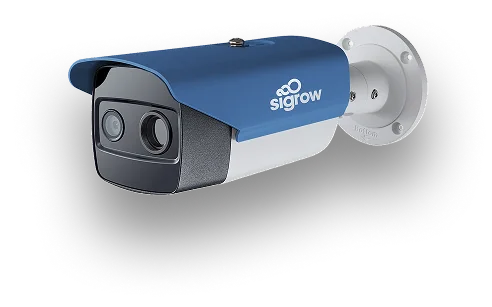
Crop-centric steering like this depends on seeing the crop, not just the air. Sigrow’s Stomata Camera measures crop temperature, leaf-level VPD, and stomatal behavior directly, while Pixel and Air+ and Air Pro+ track canopy microclimate, humidity, and CO₂, the data you need to push temperatures without pushing the crop into stress. It is the Plant Empowerment approach in practice.
This post was originally shared by Mihnea Paraschiv on LinkedIn. Read the original post →
Want to discuss your greenhouse climate strategy? Reach out to Mihnea and the Sigrow team at success@sigrow.com (Mon to Fri, 9:00 to 18:00 CET) or support@sigrow.com (Mon to Fri, 9:00 to 21:00 CET).
Follow Sigrow on LinkedIn for more insights from the field.
Author

Related Blogs

- Grower Insights
By SigrowWarm Days, Cold Nights: Why Your Tomato Crop’s Dew Point Margin Matters
A respectable 24-hour average can hide a night on the dew point and…- Grower Insights
By SigrowSpectral Solar Panels Keep Greenhouses Cooler — Why Plant Temperature Monitoring Matters
Nieuwe Oogst covers Voltiris spectral panels that filter NIR while passing PAR light….- Grower Insights
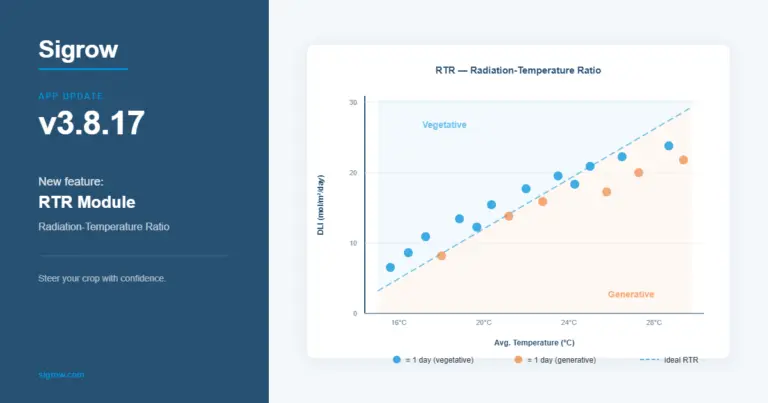
By SigrowMore Light or More Temperature? How RTR Answers the Question
Light makes the sugars, temperature spends them. RTR connects the two and shows…

No Related Blogs Found
120-Day Promise
Try Sigrow for 120 days, risk-free. If it does not get your operation under tighter control, send the system back for a full refund of the hardware and the software subscription paid to date — no restocking fee.
We’re here to support you.
Questions, assistance, or just want to chat – reach out!