A new field report from Delfgauw confirms what leaf-level sensor data has been hinting at for years: Mycosphaerella in LED cucumber is, at its core, a transpiration problem. The shift from HPS to LED changes the transpiration equation, and the control strategies that worked under 85 µmol don’t translate to 200 µmol.
Dutch horticulture title Groentennieuws published a field report and photography by Thijmen Tiersma following cucumber growers Marco and Mike Zuidgeest (Zuidgeest Komkommers, Delfgauw) through three seasons of fighting Mycosphaerella after switching to full LED. The piece features independent greenhouse researcher Peter van Weel of Weel.Invent, together with Glastuinbouw Nederland and Sigrow as the sensor partner on the project. It’s worth reading in full — below we summarize the diagnosis, and look at what it means for the way growers measure and steer transpiration under LED.
LED cucumber Mycosphaerella: when the light went up and transpiration didn’t
Zuidgeest moved from 85 µmol HPS to 200 µmol LED and ran straight into widespread Mycoskoppen (fungal heads). Early fixes — removing fallen leaves, raising the heating tube — didn’t break the cycle. Three seasons in, the real problem was still on the table.
Peter van Weel’s diagnosis in the article: root pressure and transpiration were out of balance. With LED, the radiant heat that used to come with HPS was gone, the canopy stayed cooler, stomatal behavior shifted, and guttation at the head created exactly the wet microclimate Mycosphaerella needs. On paper the greenhouse was uniform. At the plant, it wasn’t. Van Weel is blunt about the pattern: spring transitions — warm sunny days into cold, wet nights — are when the problem reliably bites.
The diagnosis: it’s a control issue, not a hardware issue
The Airmix ventilation was working. The screens were working. What failed was the coordination between them. The system kept tripping itself into over-cooling the canopy, cutting transpiration at exactly the moment the plant needed to dump moisture. Van Weel’s recommendation in the piece: measure absolute vapor content (AV) above the shade cloth, inside the greenhouse, and outdoors, and use that differential to drive the Airmix valves.
The Zuidgeest fix after that reframing:
- Heating tube positioned roughly 20 cm above the canopy to radiate heat into the plant rather than the air.
- Screen strategy tuned to stop bleeding off radiation to the cold sky.
- Airmix cold-air injection dialed back.
- Continuous reading of the AV differential driving the logic.
Result reported in the article: significantly fewer Mycos problems. Van Weel’s headline number: around 80% reduction is achievable with manual control, with full automation closing the last 20% by reacting faster than a human can. He frames the whole issue as a control problem that requires coordinated optimization of screening strategy, window openings, dehumidification, and heating — not a single piece of hardware.
Where leaf-level sensing comes in

Three things the article identifies as the real control variables — canopy temperature, transpiration at the head, and the vapor differential between inside and outside — are exactly the variables that don’t show up cleanly on a standard greenhouse climate computer. A traditional box sensor gives you air temperature and relative humidity somewhere between the rows. It doesn’t tell you whether the stomata are open, whether the leaves are radiating cold to the screen (which is what a Net Radiometer is built to quantify), or whether transpiration has stalled at the head.
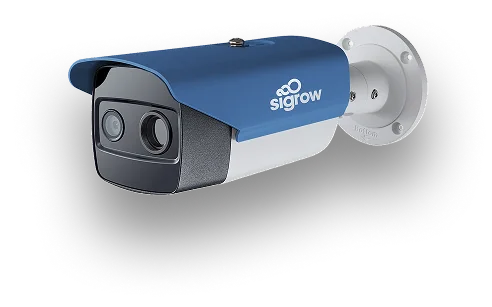
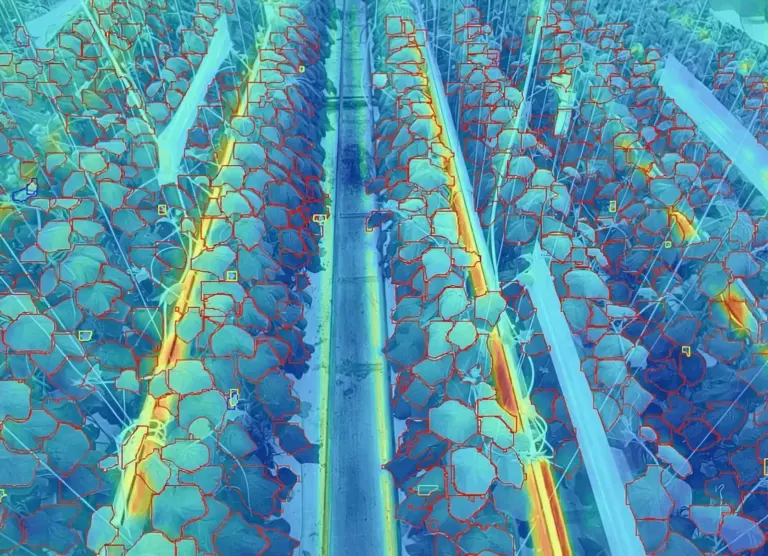
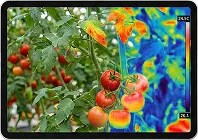
That’s the gap the Stomata Camera is built for: a patented fusion of RGB and thermal imaging with AI plant segmentation, reading leaf and fruit temperature, stomatal behavior, leaf-level VPD, PAR, and Real RTR (Real Transpiration Rate) directly off the crop. When Van Weel talks about “transpiration loss at the canopy,” Real RTR is the quantitative read of it — the actual water the plant is moving, not a modeled estimate.

Pixel, Sigrow’s solar-powered wireless microclimate sensor, fills in the canopy side: point temperature to ±0.3 °C, relative humidity 0–100%, dew point, and leaf-level VPD right at the head of the crop. A handful of Pixels distributed across the LED zones is how you catch the uniformity gap the article describes — where the Airmix looked fine on paper but the plants at the head were too cold and guttating. Together with the Stomata Camera they feed the AV and VPD differential Van Weel is asking for, and because Pixel talks to Priva, Hoogendoorn and Ridder climate computers over API, the signal goes straight into the Airmix and screen logic instead of living in a separate dashboard.
The Plant Empowerment lens
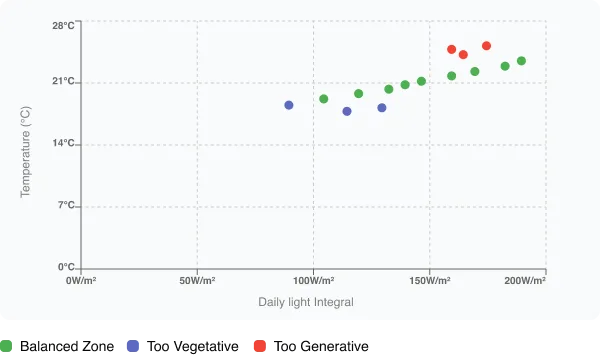
The problem described in the article sits squarely in Steps 3 and 4 of Plant Empowerment: Moisture Balance and Assimilation. Under HPS, those two stayed roughly coupled because the lamps warmed the canopy. Under LED they don’t, and the growers who catch the gap early are the ones measuring transpiration and leaf-level VPD at the plant — not just room climate a few meters away. It is the same shift Van Weel has been arguing for across multiple LED trials: move the measurement to the plant, and the control loop follows.
Takeaway: LED cucumber Mycosphaerella is a control problem
The Zuidgeest case is a clean field-scale confirmation of what the physics predicted for LED cucumber Mycosphaerella: LED decouples radiation from canopy heat, transpiration stalls, guttation wets the head, the fungus wins. The fix is not more hardware — it’s reading the right variables, at the plant, and letting them drive the climate computer. Van Weel’s 80% headline is not a ceiling; it’s the floor for growers who still rely on generic room climate.
Full credit to the grower and to Peter van Weel in the Groentennieuws article, and thanks to Groentennieuws for consistently covering the research-driven side of Dutch greenhouse practice.
If you’re running LED and seeing the same Mycos pattern, reach out to our team: success@sigrow.com · +31 6 450 500 55 (WhatsApp available) · Monday–Friday 9:00–18:00 CET. For technical questions on existing installs: support@sigrow.com, Monday–Friday 9:00–21:00 CET.
Author

Related Blogs

- Grower Insights
By SigrowSpectral Solar Panels Keep Greenhouses Cooler — Why Plant Temperature Monitoring Matters
Nieuwe Oogst covers Voltiris spectral panels that filter NIR while passing PAR light….- Grower Insights
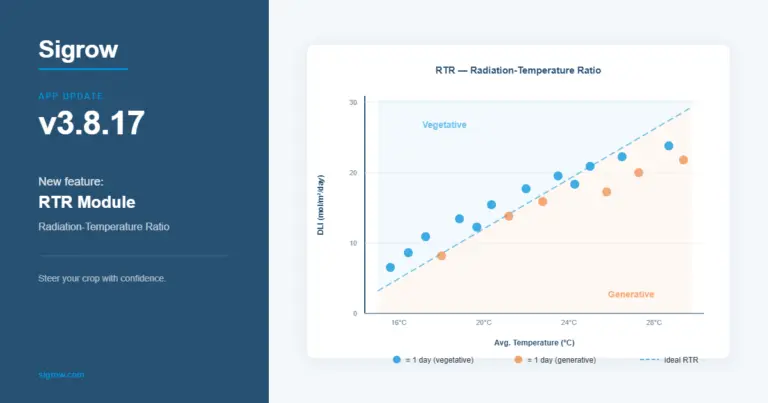
By SigrowMore Light or More Temperature? How RTR Answers the Question
Light makes the sugars, temperature spends them. RTR connects the two and shows…- Grower Insights
By SigrowLimiting Ventilation in a Heatwave: What Crop VPD Shows
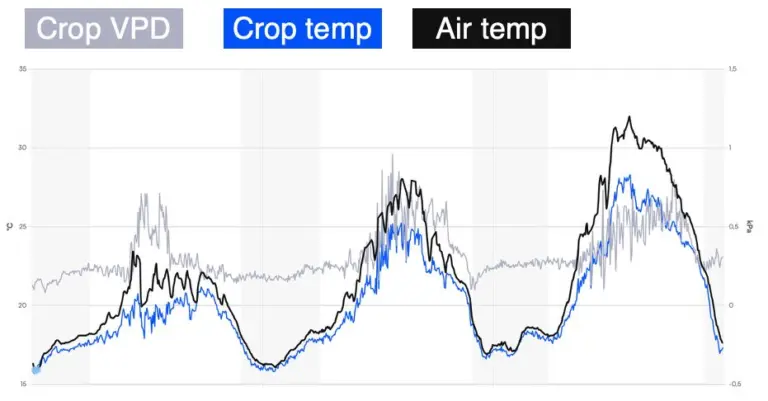
Air and crop temperature both climbed for days. Crop VPD stayed below stress…

No Related Blogs Found
120-Day Promise
Try Sigrow for 120 days, risk-free. If it does not get your operation under tighter control, send the system back for a full refund of the hardware and the software subscription paid to date — no restocking fee.
We’re here to support you.
Questions, assistance, or just want to chat – reach out!