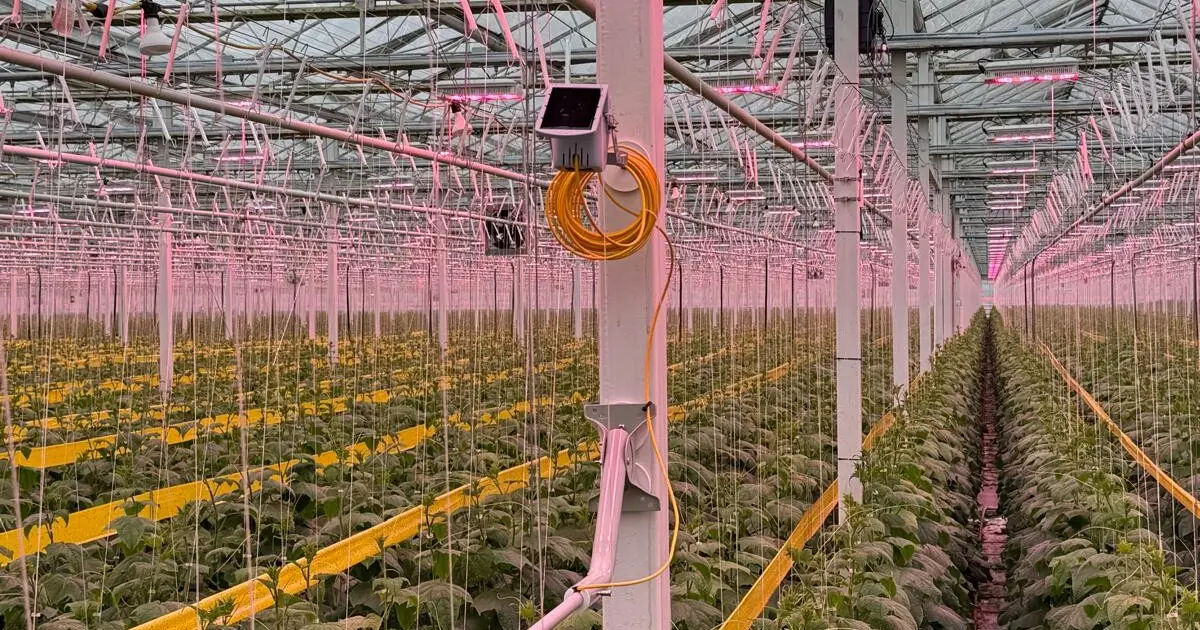
Case study · Zuidgeest Komkommers, Delfgauw, the Netherlands · High-wire cucumbers under full LED
At a glance
| Grower | Zuidgeest Komkommers, Delfgauw, the Netherlands |
| Crop | High-wire cucumbers |
| Lighting | From 85 µmol/m²/s HPS to 200 µmol/m²/s full LED |
| Greenhouse | Airmix system, double energy screens |
| Problem | Mycosphaerella (Mycos) outbreaks after the switch to LED |
| Measured with | Stomata Camera, Net Radiometer, infrared screen temperature, air and humidity sensors |
| Result | About 80% fewer Mycos problems with manual climate control |
| Partners | Weel.Invent, Glastuinbouw Nederland, Sigrow |
Overview
Zuidgeest Komkommers grows high-wire cucumbers under full LED. After the switch from HPS, Mycosphaerella, also called gummy stem blight, became a recurring problem.
Together with Weel.Invent, Glastuinbouw Nederland and Sigrow, the nursery measured what the crop itself was experiencing: leaf temperature, net radiation, the temperature of the screen above the crop, and humidity inside, above the screen and outside.
The data showed that the light was not the cause. Control was. With changes to heating, dehumidification and screening, the nursery cut Mycos problems by about 80% with manual climate control alone.
The challenge: a cooler crop under LED
Zuidgeest moved from 85 µmol/m²/s HPS to 200 µmol/m²/s LED. LED gives the light without the radiant heat that HPS lamps put on the crop. The top of the crop ran cooler than before, and the climate settings were still tuned for HPS.
A cooler crop transpires less. When transpiration stays low and the roots keep pushing water up, moisture ends up in and on the plant: guttation at the head, condensation on the leaves, and a wet microclimate where Mycos thrives. Outbreaks came back season after season.
The Airmix system and the double energy screens were in place. Each worked on its own. What was missing was a view of how they worked together on the crop.
Goals
- Find out why Mycos increased under LED
- Get transpiration going again without wasting energy
- Turn the findings into climate settings the grower can use every day
The Sigrow solution
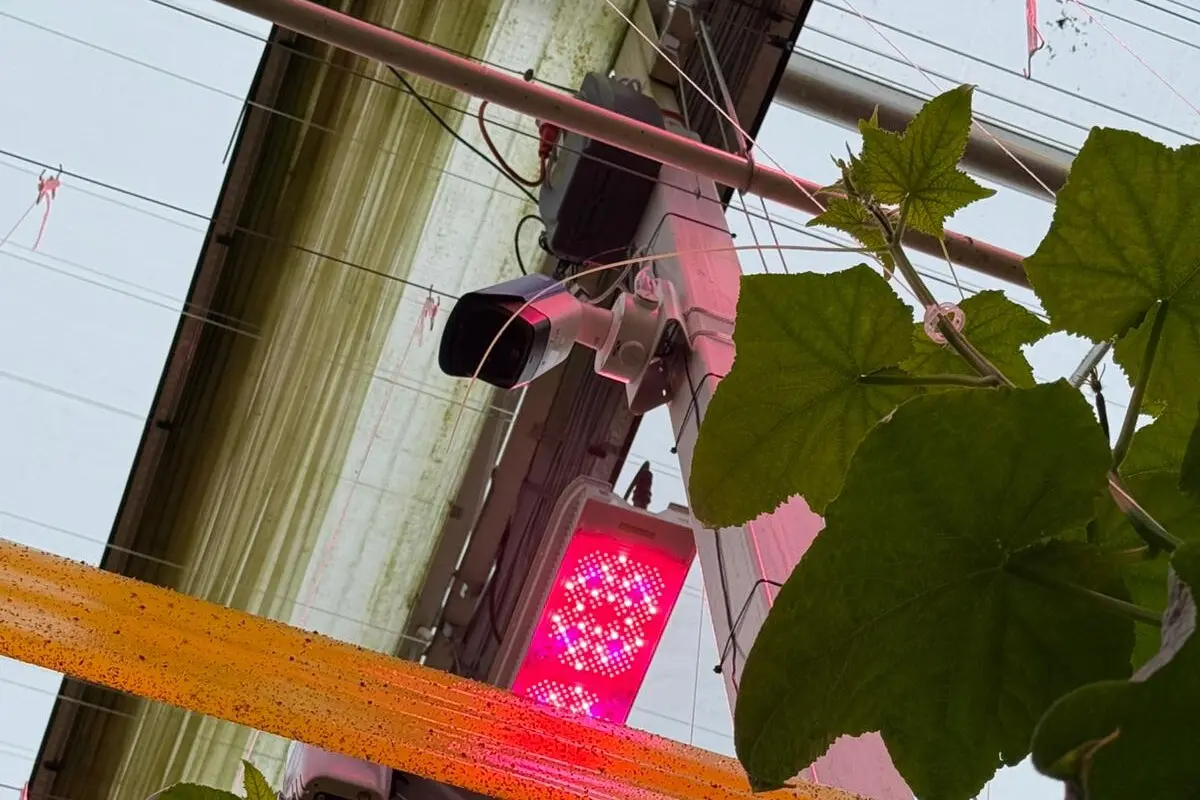
Sigrow installed a crop monitoring setup in the greenhouse:
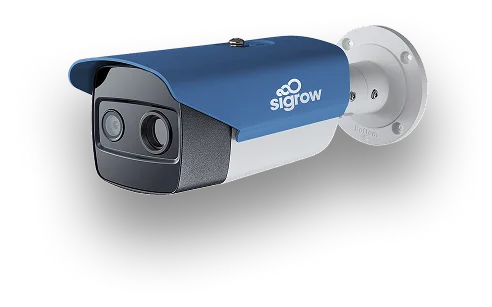
- Stomata Camera with automatic leaf recognition above the crop head, one under a row of Airmix fans and one between two rows, for leaf temperature
- Net Radiometer just above the crop head, for the radiation balance of the crop
- Infrared sensor measuring the temperature of the lower screen
- Sensors for air temperature, relative humidity and PAR at the crop head and lower in the crop
- Humidity readings above the screen, inside the greenhouse and outside, so the Sigrow app could show the difference in absolute humidity between them
The research was led by Weel.Invent with support from Glastuinbouw Nederland. Van der Ende Group supplied the Airmix system.
What the data showed
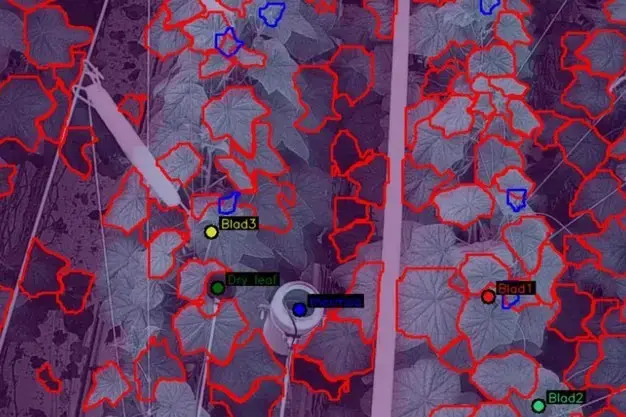
The air was even. The crop was not. Smoke tests and air measurements showed that air from the Airmix spread well through the greenhouse, also between the rows of fans. Air temperature looked uniform. Leaf temperature told a different story: on some evenings the leaves under the Airmix row ran colder than the leaves between the rows.
Evenings were the critical moment. On one evening the screen cooled down too fast and net radiation at the crop head dropped to −40 W/m². The crop was losing heat upward, the leaves cooled, and transpiration stopped. The next evening, a small gap in both screens, with the Airmix and vents kept off, stopped the screen from cooling that fast. The data then raised the next question for the grower: was the gap needed at all, or was there already enough heat in the greenhouse before the screens closed?
Without lamp heat, the crop head needs heat from below. With the growing pipe at 30 °C, net radiation at the crop head sat at about −12 W/m². Raising the pipe to 40 °C brought it to about −7 W/m². Less heat lost to the roof means a warmer leaf and more transpiration at the head.
Dehumidifying got harder as the outside air got wetter. In the evening, the Airmix was used less just as the outside air grew more humid. The greenhouse got wetter and the crop found it harder to transpire. The absolute humidity difference between outside, above the screen and inside showed when the Airmix and vents could do more.
Actions taken
- Growing pipe placed about 20 cm above the crop head, and set warmer, so the top of the crop gets heat from below
- Screens kept closed as much as possible to stop cold air dropping onto the crop
- Vent opening steered on the absolute humidity difference between outside and above the screen
- Airmix dehumidification steered on the absolute humidity difference between above the screen and inside, with the outlet temperature only used as a limit, measured about 3 m behind the fan
- A gap in the lower screen first, and in the upper screen only if needed, when humidity climbed or transpiration stayed too low
- Leaf temperature and net radiation used to steer climate, not air temperature alone
- Picked leaves removed quickly to cut moisture and spore load
Results
| Before (first LED seasons) | After | |
|---|---|---|
| Mycosphaerella | Recurring outbreaks | About 80% fewer Mycos problems |
| Net radiation at the crop head, dark period | About −12 W/m² (pipe at 30 °C) | About −7 W/m² (pipe at 40 °C) |
| Transpiration at the crop head | Too low | Higher |
| Climate control | Settings tuned for HPS | Steered on leaf temperature, net radiation and humidity differences |
“Around 80% reduction of Mycosphaerella is already possible with good manual climate control. With automation, we believe we can go even further.”
Rutger Vreezen, Data Driven Growing Specialist, Sigrow
Key takeaways
- Under LED, the crop loses the radiant heat it got from HPS. Heating, screening and dehumidification all need to be tuned again.
- Mycos under LED is a control problem. That means it can be measured and fixed.
- Even air does not mean an even crop. Leaf temperature and net radiation show where the crop gets too cold, long before Mycos shows up.
- A warmer pipe close to the crop head is a small change with a measurable effect on how much heat the crop loses at night.
Frequently asked questions
Why does Mycosphaerella increase in LED cucumbers?
LED lamps give much less radiant heat than HPS lamps. The top of the crop becomes colder, transpires less and stays wet for longer, and that is the climate Mycosphaerella needs.
What reduced Mycos at Zuidgeest Komkommers?
A combination of changes: a warmer growing pipe close to the crop head, screens kept closed to stop cold air falling onto the crop, and vents and Airmix steered on the absolute humidity difference. Leaf temperature and net radiation showed whether each change worked.
How do you see if a cucumber crop is too cold at night?
Measure the plant, not only the air. A thermal camera with leaf recognition shows leaf temperature, and a net radiometer above the crop shows how much heat the crop is losing to the roof.
Is this the same as Sigrow’s powdery mildew case?
No. That case is about early detection of powdery mildew in snack cucumbers. This one is about cutting Mycosphaerella problems through climate control under LED. For the grower’s side of the story, read Less Mycos in LED cucumber.
About Zuidgeest Komkommers
Zuidgeest Komkommers is a family nursery in Delfgauw, the Netherlands, run by Marco and Mike Zuidgeest. They grow high-wire cucumbers under full LED, with an Airmix system and double energy screens.
Is your crop colder than your climate computer shows?
Growing cucumbers under LED, or planning the switch? Our plant scientists can show you what your crop does on a winter evening, before Mycos does.
success@sigrow.com (9:00 to 18:00)
Related Case Study
 3 minutes
AI-Powered Powdery Mildew Detection in Snack Cucumbers
Sigrow deployed AI-powered disease detection in a major Dutch snack cucumber greenhouse. Using thermal imaging and stomatal analysis, the system catches powdery mildew days before visible symptoms — enabling targeted crop protection instead of blanket spraying.- Agriculture
120-Day Promise
Try Sigrow for 120 days, risk-free. If it does not get your operation under tighter control, send the system back for a full refund of the hardware and the software subscription paid to date — no restocking fee.
We’re here to support you.
Questions, assistance, or just want to chat – reach out!