Mid-July is here, and with it the usual question:
Can limiting ventilation actually reduce heat stress in greenhouses?
It sounds counterintuitive. Less ventilation means higher temperatures, but temperature alone is not what stresses the crop. And the principles of Plant Empowerment Academy explain how that works out.
What happens to crop VPD when you hold the vents back
When ventilation is reduced during hot periods, more humidity is retained inside the greenhouse. As a result, crop VPD can remain within a healthy range, even when air temperatures exceed 30 °C. Combined with adequate CO₂ levels, the crop can maintain good stomatal opening, efficient photosynthesis, and continue performing at a high level.
The goal is not simply to achieve the lowest possible air temperature, it is to create the best conditions for the crop.
What we saw in the data over several hot days
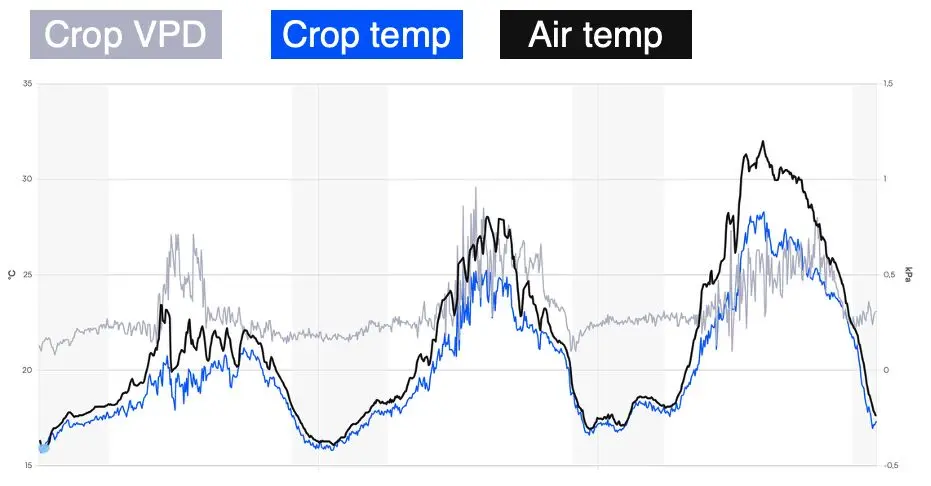
We recently observed this strategy in practice. Over several days, both air and crop temperatures increased, but because humidity was maintained, crop VPD remained below stress levels. Looking only at temperature, you would conclude the crop was under heat stress. Looking at crop VPD, the crop was actually operating close to its optimum.
In the chart above, crop VPD stays inside the healthy band while both crop temperature and air temperature climb through the hottest part of the day.
Why air climate alone is the wrong dial to steer on
This is exactly why crop-centric measurements such as crop temperature and crop VPD provide a much more complete picture than air climate measurements alone. They help growers understand how the crop is responding, rather than relying on greenhouse conditions as a proxy.
Have you experimented with limiting ventilation during heatwaves? We’d be interested to hear about your experience.
For the full background on why this works, read Can Limiting Ventilation Solve Heat Stress in Greenhouses? and Greenhouse Ventilation in Extreme Heat: Why VPD Spikes.
Reading the crop instead of the air is what makes this steering possible. Sigrow’s Stomata Camera measures crop temperature, leaf-level VPD and stomatal behavior directly, while Air+ and Air Pro+ keep watch on humidity and CO₂. You can also check your own numbers against the healthy range with our free VPD calculator.
This post was originally shared by Sigrow on LinkedIn. Read the original post →
Want to discuss heat management in your greenhouse? Reach out to the Sigrow team at success@sigrow.com (Mon to Fri, 9:00 to 18:00 CET) or support@sigrow.com (Mon to Fri, 9:00 to 21:00 CET).
Follow Sigrow on LinkedIn for more insights from the field.
Author

Related Blogs

- Grower Insights
By SigrowWarm Days, Cold Nights: Why Your Tomato Crop’s Dew Point Margin Matters
A respectable 24-hour average can hide a night on the dew point and…- Grower Insights
By SigrowSpectral Solar Panels Keep Greenhouses Cooler — Why Plant Temperature Monitoring Matters
Nieuwe Oogst covers Voltiris spectral panels that filter NIR while passing PAR light….- Grower Insights
By SigrowMore Light or More Temperature? How RTR Answers the Question
Light makes the sugars, temperature spends them. RTR connects the two and shows…

No Related Blogs Found
120-Day Promise
Try Sigrow for 120 days, risk-free. If it does not get your operation under tighter control, send the system back for a full refund of the hardware and the software subscription paid to date — no restocking fee.
We’re here to support you.
Questions, assistance, or just want to chat – reach out!