How Proefcentrum Hoogstraten used Sigrow’s Soil Mini to improve irrigation
Industry: Agriculture / Research | Reading time: 7 minutes | Crop: Everbearing strawberry (cv. Karima) | Location: Proefcentrum Hoogstraten (PCH), Meerle, Belgium | Sigrow product used: Soil Mini substrate sensor | Year: 2023 | Research project: EU Life ACLIMA project (LIFE20-CCA-BE-1720)
Overview
Sustainable water use has become one of the biggest challenges in modern strawberry cultivation — and the tabletop systems used across Northern Europe are one of the toughest places to fix it. In 2023, Proefcentrum Hoogstraten (PCH) ran a full-season trial with Sigrow Soil Mini substrate sensors to find out whether sensor-driven irrigation could reduce drain water on a Mini-Air tabletop system with free drainage.
The results were striking. Indeed, by using continuous substrate moisture and EC data to steer irrigation in the second half of the season, PCH cut overall water use by 19.5% (from 520 to 419 L/m²) and reduced drain water by 38% (from 189 to 118 L/m²) — all without any loss in yield, fruit size, firmness, Brix, or shelf life. Moreover, both trial sections produced nearly 2 kg per plant, or roughly 10 kg/m², with 75% of fruit sorted as large.
For growers running tabletop strawberries on free-draining tables, therefore, the conclusion is clear: substrate sensors aren’t just diagnostic tools — they’re a practical lever for cutting water waste while protecting yield.
The Challenge: Free-Draining Tabletop Strawberries Are a Water Blind Spot
Over the past twenty years, Belgian and Dutch strawberry growers have made serious progress on sustainable water use. For example, most production greenhouses now recirculate drain water and capture rainwater on-site — often more than 3,000 m³ per hectare. As a result, those investments have closed the loop on indoor production cycles.
However, one system has stayed stubbornly open: outdoor or covered tabletop cultivation with free drainage. These are the raised-table strawberry systems growers use from April through September, with grass underneath the tables and no drain recovery. Any water that exits the pots soaks away into the soil below. In short, it’s water that’s simply lost.
The question PCH wanted to answer was straightforward: can we safely reduce drain on these systems without hurting the crop? And more specifically — can substrate sensors tell us when it’s actually safe to hold back water?
Why the traditional approach leaves water on the table
In standard strawberry fertigation, growers dose nutrients at low EC (typically 1.1–1.5 mS/cm) with every drip cycle. They then steer the volume of water and the chosen drip EC using two numbers they read at the drain: the drain percentage and the drain EC.
Typically, target drain percentages range from 15% on dull days up to 40% on bright, sunny days. Target drain EC sits around 1.1–1.3 mS/cm for everbearers and around 1.5 mS/cm for June-bearers. In practice, growers steer toward those values by adjusting the number and length of drip cycles, often using light-integral triggers like “give 100 ml per dripper for every 120 J/cm² of accumulated light.”
It works — but it’s indirect. After all, drain percentage and drain EC tell you what already happened inside the substrate several hours earlier. You’re steering by a rear-view mirror. Furthermore, on free-draining tables, any drain percentage above zero is water you’ll never see again.
Goals & Objectives
PCH designed the 2023 trial to answer a specific set of questions:
- Can substrate sensors give growers enough confidence to safely reduce drain water on tabletop systems?
- What moisture and EC thresholds in the substrate are safe limits before the crop suffers?
- Does sensor-driven irrigation maintain or improve fruit yield, size, and quality?
- Can the approach work with an everbearing variety like Karima, which is more sensitive to irrigation swings than June-bearers?
The Sigrow Solution
To answer those questions, PCH purchased six Sigrow Soil Mini substrate sensors to monitor the trial. Specifically, the Soil Mini targets organic substrates and measures the parameters that matter most in strawberry cultivation:
What was measured:
- Substrate moisture content (%) — the primary signal for irrigation decisions
- Substrate EC (mS/cm) — to track nutrient concentration in the root zone
- Substrate temperature
- Ambient light
- Vapor pressure deficit (VPD)
For this trial, moisture and EC were the two parameters that mattered most. The sensors still tracked the others in the background, although the team did not act on them directly.
Splitting the Mini-Air into a control and a test section
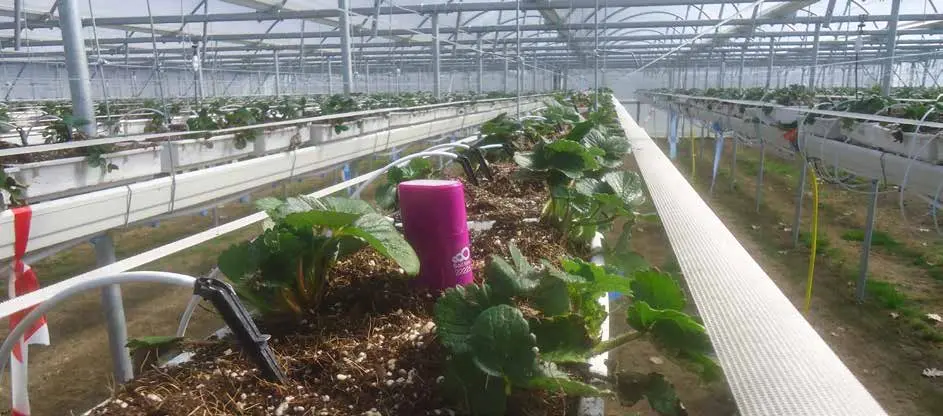
The trial ran on a Mini-Air tabletop system, planted with the everbearing variety Karima on 29 March 2023. PCH then divided the six sensors evenly across two sections:
- Control section: three sensors, irrigated from PCH’s central technical room using the standard drain-steered strategy.
- Test section: three sensors, irrigated from a separate, dedicated fertigation unit that could be steered directly from sensor data.
Because the trial used low Meerle trays (shallow tabletop containers), the team couldn’t measure at multiple heights in the substrate. Instead, each section placed one sensor in a root ball in the corner of the tray, one in a root ball in the middle of the tray, and one in the free substrate between root balls. As a result, PCH got a full picture of how moisture and EC moved through different zones.
Phase 1: Learning to Read the Data (April – mid-July)
For the first ~3.5 months of the season, PCH deliberately irrigated the test section the same way as the control. The goal wasn’t to save water yet — instead, it was to learn how the sensor values behaved under a known, traditional irrigation strategy.
This phase proved essential for two reasons:
- It built a clear baseline of what “normal” substrate moisture and EC looked like across the root balls and the free substrate at different stages of the crop.
- It caught a real operational problem. On 28 June, the drain-EC measurements showed that the dedicated unit was suddenly dripping at a very high EC — the result of an unexplained EC spike in the rainwater tank feeding that unit. The team immediately drained the tank and refilled it with clean rainwater. However, the short EC peak left a visible fingerprint in the substrate data for weeks afterward, especially in the sensor sitting in the middle root ball of the tray. Without continuous substrate monitoring, that contamination would likely have gone unnoticed.
From that experience, PCH also drew an important early conclusion: substrate EC is less reliable than drain EC as a day-to-day steering signal. Specifically, substrate EC rose over time (especially in the root balls), while drain EC remained within the target band. Clearly, the two numbers told different stories — so the trial adjusted accordingly.
Phase 2: Sensor-Driven Irrigation (mid-July – end of season)
From mid-July onward, the test section switched to sensor-driven irrigation. Based on what the first phase had revealed, PCH established clear substrate moisture thresholds:
- Minimum 40% moisture in the root balls — the zone where active root uptake happens
- Minimum 30% moisture in the free substrate between root balls — acceptable to let this dry back further, since there’s less active root mass
- Drain EC held between 1.1 and 1.3 mS/cm — the standard target range for Karima everbearers
- Substrate EC allowed to climb freely, as long as drain EC stayed in target
The sensors recorded continuously, although PCH did not automate the dedicated fertigation unit. Instead, staff checked the substrate moisture data several times a week and made manual irrigation decisions: hold back water when moisture was above target, add a drip cycle when moisture approached the minimum, or increase water if drain EC began rising sharply.
As a rule, PCH kept drip cycles to the minimum the crop actually needed — not the maximum the system allowed.
Data Insights & Analysis
The continuous sensor data made several things visible that drain-only monitoring had always hidden. In particular, four findings stood out.
Moisture held up far better than expected
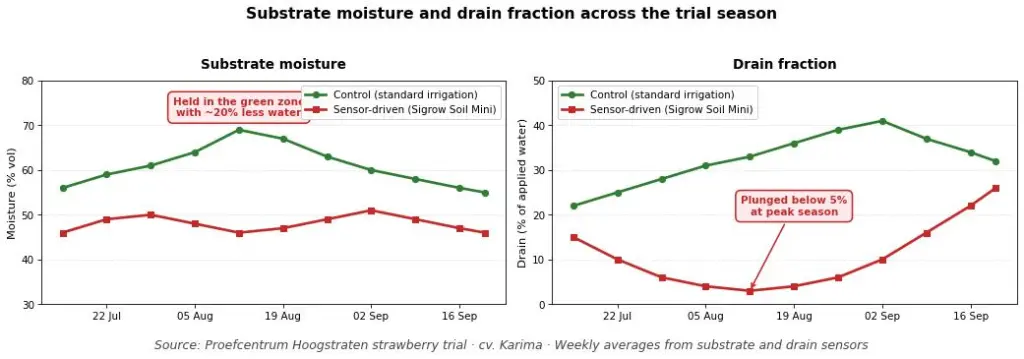
First, even with significantly fewer drip cycles than the control, substrate moisture in the root balls stayed comfortably above the 40% target for most of the second half of the season. In short, the crop had reserves in the substrate that drain-steered irrigation had been pushing through unnecessarily.
Drain percentages plunged below 5% at peak season
Second, by late July the test section was running at drain percentages well under 5% — far below the traditional 15–40% targets — while drain EC stayed inside the target window. In other words, the crop was simply getting what it needed, rather than a built-in safety margin of extra water on top.
EC accumulation in the root balls became visible in real time
Third, substrate EC climbed steadily through the season, especially in the corner and middle root balls — reaching 8–9 mS/cm in September. Meanwhile, drain EC stayed between 1.3 and 1.8 mS/cm. That gap reinforced the Phase 1 finding: in Karima on tabletop Mini-Air systems, substrate EC can drift high without drain EC showing it. Therefore, drain EC remains the more trustworthy day-to-day steering signal — but substrate EC is still valuable as a longer-term trend alert.
Irrigation timed to the crop, not the clock
Finally, because moisture was visible in real time, irrigation decisions stopped being calendar-driven (“give a cycle every 120 J/cm²”) and started being response-driven (“give a cycle when moisture approaches 40% in the root ball”). On many days, that meant fewer cycles. On a few hot days, however, it meant more. Either way, it was precise.
Actions Taken
Based on the continuous sensor data, the PCH team:
- Shifted the test section from calendar-based drip scheduling to moisture-threshold–based scheduling starting mid-July
- Reduced the number of daily drip cycles wherever root-ball moisture stayed above 40%
- Added cycles proactively when drain EC started climbing
- Detected and fixed the 28 June rainwater tank contamination before it caused lasting damage
- Built a clear set of substrate moisture targets for Karima on tabletop Mini-Air systems that can be reused in future trials and commercial advice
Results & Impact
Over the full season, the numbers tell a clean story:
Water use
- Control: 520 L/m²
- Sensor-driven: 419 L/m²
- Savings: 19.5% less water applied
Drain water produced
- Control: 189 L/m²
- Sensor-driven: 118 L/m²
- Reduction: 38% less drain water lost
And crucially — this reduction came even though PCH only applied sensor-driven irrigation for the second half of the season. Had the team run the approach from day one, the savings would almost certainly have been larger.
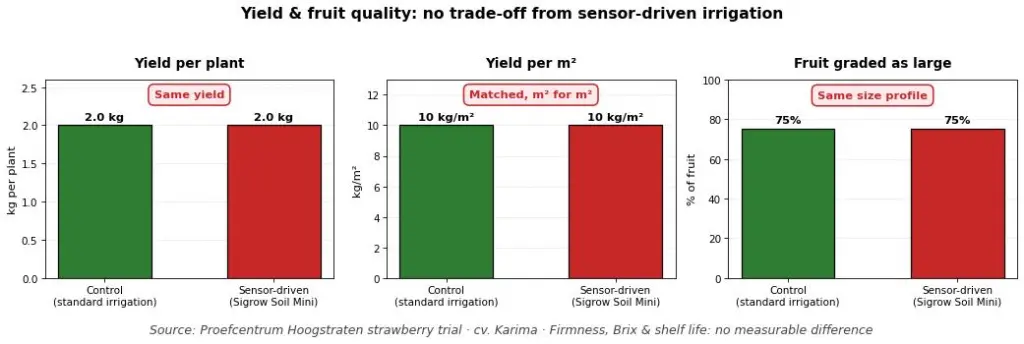
Yield and fruit quality: no trade-off
Of course, the real test of any water-reduction strategy is whether it hurts the crop. In this trial, it simply didn’t.
- Yield: Both sections produced approximately 2 kg per plant, or 10 kg/m²
- Fruit size: 75% of fruit graded as large in both sections
- Firmness: No measurable difference
- Visual quality: No measurable difference
- Brix (sugar content): No measurable difference
- Shelf life: No measurable difference
In other words: the crop didn’t notice. It produced the same weight, the same size distribution, and the same quality — on 19.5% less water and 38% less drain.
Key Takeaways
- Substrate sensors turn drain reduction into a data-backed decision. On free-draining tabletop systems, sensor-driven irrigation can cut drain water by close to 40% without yield or quality loss.
- Drain EC remains the most reliable day-to-day steering signal for Karima on tabletop Mini-Air systems — but continuous substrate moisture data is what actually lets growers pull back on irrigation with confidence.
- The 40% / 30% moisture rule works in practice. PCH’s experience shows that root-ball moisture can be safely managed down to 40%, and free-substrate moisture to 30%, for everbearing Karima.
- Continuous monitoring catches problems traditional fertigation hides — like the June rainwater tank EC spike, which would otherwise have gone undiagnosed until crop damage was visible.
- Water savings scale with time on the system. This trial only applied sensor-driven irrigation for roughly half the season. A full-season rollout would likely push savings higher.
- Sigrow Soil Mini sensors are suited to organic substrates and deliver the moisture, EC, and environmental data needed for this kind of precision water management in strawberry cultivation.
About Proefcentrum Hoogstraten
Proefcentrum Hoogstraten (PCH) is one of the leading applied research centers for strawberry and vegetable cultivation in Belgium, based in Meerle. The center runs commercial-scale trials on behalf of growers and industry partners across Europe, focused on sustainable cultivation techniques, water management, climate adaptation, and crop innovation.
About the Life ACLIMA project
PCH carried out this work within the Life ACLIMA project, which the European Union’s Life programme funds under grant number LIFE20-CCA-BE-1720. The ACLIMA project supports climate adaptation in horticulture by developing and validating practical tools for sustainable water and resource management.
Reference
This case study is based on published research by P. Melis, S. Laurijssen, M. Hofkens & V. Greffe (Proefcentrum Hoogstraten, Meerle), originally reported in:
“Drain in aardbeien te beperken met behulp van sensoren” — Proeftuinnieuws 20, 24 November 2023, pages 11–13.
Interested in sensor-driven irrigation for your crop?
Sigrow’s Soil Mini is part of a full suite of substrate and climate sensors built for commercial growers and research centers. If you’re working on water reduction, drain management, or precision fertigation in strawberries, tomatoes, or other substrate-grown crops, get in touch with our team — we’d love to help you design a sensor strategy that fits your operation.
Related Case Study
 2 minutes
Blom Kentia Palms- Mastering Growth Through Precision Data
Blom Kentia Palms is a family business that runs one of the most modern palm nurseries in Europe. Located in Aalsmeer, they supply customers worldwide with their Kentias. Our continuous data measurement was especially useful for their growth optimization.- Horticulture
120-Day Promise
Try Sigrow for 120 days, risk-free. If it does not get your operation under tighter control, send the system back for a full refund of the hardware and the software subscription paid to date — no restocking fee.
We’re here to support you.
Questions, assistance, or just want to chat – reach out!